Showing posts with label Seinfeld. Show all posts

29 December 2024

IT’S THE FINAL COUNTDOWN [481]


Instead of always thinking about the next article, I have been persuaded to look back on my writing in the last year. Without going into all fifty-one of them, I have compiled lists of my ten most-read articles published in 2024 – fortunately, I am happy with the quality of all of them – followed by five that I think should get an extra mention.

I don’t see any deliberate connections between approach or subject matter between them, which is a good thing, as I don’t want to be tied down to a predictable formula. However, I do see that they are the products of reactions, either to personal experience or to the news. There is scope for more approaching subjects in a more creative fashion, and to go into greater depth on some subjects, so do expect some experimentation in 2025 – judging from what topped the most-read list below, I had better start exploring approaches to cybernetics, and the cyber-society in which we find ourselves.

I can see the articles listed below cover a lot of ground, which I hope is an indication of confidence. My five hundredth article will appear here during 2025, most definitely the result of perseverance from week to week. Oddly enough, it is only during this year that a couple of ground rules have made themselves known to me: aim to pass five hundred words, but hope to reach a thousand; and attempt to sum up the point you want to make in the first sentence, like how the below piece about Jaguar began: “Creativity doesn’t have to make sense to you personally, even in advertising.” I may have got that last idea from reading something about Stephen King.

Eight out of the ten most-read articles were been published in the last three months, which I have put down to my having ditched Twitter in favour of Bluesky – my handle is @leighspence.bluesky.social – which thankfully feels like the egalitarian Twitter of old. Having locked my “X” account in response to its owner’s twisting the site’s experience out of all recognition, the switch to Bluesky pretty much confirms that links to external sites from “X” were being throttled – once my local bus company stops using “X” for service updates I am deleting the app altogether. I hope to use social media more in 2025 to let people know what they can find here, now that the dust from the social media square-dance-stampede is settling.

And so, here is the list of my most-read articles published during 2024:

1. LIKE A SHOCK TO THE SYSTEM (published 28/01/2024): nailing down a working definition of “cybernetics”, for when I eventually plan to write about cybernetics. With control and communication being key factors across the definitions I found of the word, I can only guess this is a subject that people found important, and not just entertaining to read about.

2. AND NOTHING TO GET HUNG ABOUT (24/03/2024): rediscovering “Seinfeld”, the sitcom that initially made no impact in the UK, having been relegated to midnight screening on BBC Two when Parliament was not in recess, and how it was my little secret before DVDs and streaming made it more accessible. Jerry Seinfeld made some controversial statements when promoting his new film “Unfrosted”, so I guess that added to the interest. 

3. YOU SAW THE WHOLE OF THE MOON (13/10/2024): why did ITV station Meridian Broadcasting use a half-sun, half-moon face to present television in the south of England? See under “things that lived rent-free in my head for years”.

4. BUT STILL THEY COME! (03/11/2024): being bombarded by “Jeff Wayne’s Musical Version of The War of the Worlds” in a busy shop. I don’t think I made clear that I loved listening to the album in full, but that visceral experience in HMV in Oxford Street led me to leave the store empty-handed, hardly the outcome the staff wanted.

5. TOO BUSY DODGING BETWEEN THE FLAK (10/11/2024): Donald Trump is re-elected, but I already talked about him the last time around – unlike him, I didn’t feel like re-litigating the past so, like this list, I linked to what I’ve mentioned before.

6. WE FADE TO GREY (27/10/2024): Fiat won’t sell you a grey car, as it’s not “La Dolce Vita”. This was a case of “I beg your pardon?” upon finding out both that the favourite new car colour in the UK is grey, and that Fiat saw fit to respond.

7. LIKE SUGAR AND SPICE (20/10/2024): Coca-Cola Spiced, a short-lived drink where “spiced” meant “with raspberry”. I had bought the drink, was underwhelmed about it, and with its withdrawal being announced not long afterwards, I could understand why...

8. GONE FISHIN’  (17/11/2024): the nostalgic, Proustian delights of a McDonald’s Filet-O-Fish – this one literally wrote itself, including the snap back to reality about burgers being a “sometimes” food.

9. BOYS ALWAYS WORK IT OUT (06/10/2024): constructing an article using Brian Eno’s “Oblique Strategies” card set. This one became as much of an introspective work as this article was, and has many lessons for 2025, including: “Don’t give yourself enough time to decipher or question your methods. Ritual leads the way. Deadline is style. You are in there somewhere.”

10. I’LL CALL YOU JAGUAR IF I MAY BE SO BOLD (24/11/2024): the reinvention of Jaguar, after people stopped noticing their cars. I felt indignant about the lazy use of “woke” being used to describe a creative endeavour, regardless of it being one from a multi-billion pound company, and that made this article very easy to write.

...and here is my personal list of honourable mentions:

ON WITH THE SHOW, THIS IS IT (07/04/2024) and MERRILY WE ROLL ALONG (14/04/2024): a work performance review leads into a two-part exploration of Bugs Bunny, the witty and fearless cartoon character and queer role model.

SAY HELLO, WAVE GOODBYE (31/03/2024): the death in March 2024 of Wave 105, a very popular radio station that served its local area until its owners realised the license could be fulfilled with less effort, reducing it to local news and ads on a national network. (Since then, two other stations in the same area, Nation Radio and BBC Radio Solent, took on nearly all of Wave 105’s on-air staff, with Nation Radio becoming a more local station in the process – where there’s a will...)

IF YOU’RE ALRIGHT, YOU CAN’T GO WRONG (18/02/2024): celebrating the career of Steve Wright, the immensely popular radio presenter, and discovering how he built the signature sound of his shows. “His public modesty about his own career is admirable, and while he never really got personal on air, you were always left with the impression that he was a thoroughly sincere and hard-working man.”

I'VE SEEN THAT MOVIE TOO (28/04/2024): although prompted by Jerry Seinfeld’s Pop-Tarts comedy biopic “Unfrosted”, the opening sentence, for a look at how Hollywood’s demise has been predicted many time, is definitely that of a film scholar: “To make your debut as a feature film director by declaring the death of the film industry is a trick that Jean-Luc Godard sadly missed.”

DID I TELL YOU EVERYTHING IS FINE (15/09/2024): defining “Pages from Ceefax” as a genre of music, taking in the nostalgia of watching, and listening, to teletext pages filling the gaps between TV programmes.

24 March 2024

AND NOTHING TO GET HUNG ABOUT [441]


I found myself rediscovering the sitcom “Seinfeld” recently, an incredibly easy thing to do following a multi-year, multi-national deal with Netflix keeping it constantly on demand, but the high-definition widescreen transfer made from the original Super 16 film is far away from when the show was little known in the UK, when it was found only late at night on TV, and later in DVD box sets.

Created by Jerry Seinfeld and long-time friend Larry David from conversations about the small things in life that make a stand-up routine, creating a rich and relatable seam for stories usually avoided by other sitcoms to that point, “Seinfeld” is a sharply written cultural institution in the United States, and perhaps the greatest live-action sitcom ever made there, the existence of “The Simpsons” providing that necessary qualifier. Set in the Upper West Side of New York, to the left of Central Park, Jerry Seinfeld plays a less-famous version of himself, a central point around which most events happen; Jason Alexander plays George Costanza, a Larry David analogue played as a ball of insecurities; Julia Louis-Dreyfus is Elaine Benes, Jerry’s smart and hot-tempered ex-girlfriend who successfully became a regular friend; and Michael Richards plays Kramer, Jerry’s unpredictable “hipster doofus” neighbour. I feel most people might already be aware of the set-up of “Seinfeld” by now, but I once had to explain the show to people who had never heard of it.


The outlandish plots and characters the show often used in pursuit of the biggest laugh is testament to my belief that saying something is based on a true story means nothing, despite the real-life experiences of the show’s writers making their way into episodes. I also find it an easier watch than the later shows that mine their humour from uncomfortable situations, like “The Office” and Larry David’s own “Curb Your Enthusiasm”, almost like the multi-camera filming and studio audience laughter is providing a safe distance to laugh at some of the more excruciating situations, ones that coined euphemisms like “shrinkage”, “sponge-worthy”, “master of my domain” and “...not that there’s anything wrong with that”.


What I have been watching the most recently have been the outtakes and bloopers, meticulously preserved on the DVDs and displaying both how much fun the actors and production staff had making the show, and how much Jerry Seinfeld really was playing himself on it. The show recently also spawned its own YouTube channel showing highlights, making me go back to watch the full episodes, while wishing they would release these remastered episodes on Blu-ray.


However, “Seinfeld” was probably best described as a “cult hit” in the UK during the BBC’s original broadcast of the show. It first showed up on BBC Two in 1993, on Thursdays at 9pm, on the back of the show’s huge success during its fourth season that contained famous episodes like “The Contest”, “The Bubble Boy” and “The Junior Mint”, as well as the season-long story where Jerry and George pitch a sitcom version of their own lives, a line of dialogue giving rise to the false observation that “Seinfeld” is a show about nothing at all.


However, the BBC began their broadcasts of “Seinfeld” from the start, when it was initially slower, more low-key, with fewer, longer scenes, with executives at NBC giving the show time to find itself. Infamously, the original 1989 pilot was followed with a 1990 season of only four episodes, using the budget intended for a Bob Hope special, introducing Elaine as a mandated female character, and a second season of thirteen episodes where Michael Richards started playing Kramer as the smartest man in the room, rather than the dumbest. After the first ten episodes, the BBC Two broadcasts moved to Saturdays around 10pm, slipping closer to midnight by the time the fourth season’s denser, multi-layered and often coincidental and absurdist episodes were finally shown in the UK, by which time it took over from “Cheers” as America’s favourite sitcom. The BBC should have started with the fourth season first.


My exposure to “Seinfeld” began in about 1998 with its seventh season of episodes like “The Soup Nazi”, “The Sponge”, “The Gum” and “The Invitations”, where George’s fiancĂ©e Susan dies through licking the gum on old envelopes. Relegated to cult status, the show was often used on BBC Two as filler during Parliamentary recess, and reviews of the day’s proceedings were not broadcast. Having only read text summaries of episodes online, and with my having been interested in how sitcoms were written, it had already been impressed on me that “Seinfeld” was a show that needed to be watched – I also found it to be a better show than “Friends”. 


Now able to track the BBC’s airing of the show, and through its subsequent reappearance in panel discussions and as a specialist subject on “Mastermind”, you end up realising that the biggest audience Jerry Seinfeld personally had in the UK must have been when he appeared on “Des O’Connor Tonight” in 1981, five months after his debut on “The Tonight Show with Johnny Carson”, where he worked his stand-up routines about cars and left-handedness into the conversation, and when he later appeared on “Jasper Carrott – Stand Up America” in 1987, recorded in Los Angeles.


The final broadcast of “Seinfeld” on the BBC was in October 2001, three years after it ended its run in America, but before the DVD box sets began to appear. I never kept the VHS recordings I inevitably had to make to see a show past my bedtime, but the memory of it stayed with me long enough to be rekindled on home video. I’m just glad that more people have heard of it now, an odd thing to say about such a famous show.

01 October 2022

IT’S THE MIDDLE OF SOMETHING WONDERFUL [363]


Last week, in downloading an episode of the comedy and advice podcast “My Brother, My Brother and Me” already on my phone, I realised I had caught up with myself: in the fifteen months since discovering the show, I had now heard all six hundred and twenty-eight episodes released since its debut in April 2010. 

The first I heard of the three McElroy brothers, and “MBMBAM” was the notorious moment, in “Kickeo”, episode 514, when “your babiest brother” Griffin said he was known as “Porky Pig” at high school, because of the noise made by his “technique”: “ba-de-ba-de-ba-de-ba-de...” For forty-five solid seconds, Griffin, “your oldest brother” Justin and “your middlest brother” Travis were convulsed by the kind of laughter that only comes from a moment of “where the hell did that come from?”, before Travis laments that people confuse their voices, because they will think he said it. 

As someone for whom the sound of people laughing may be their version ASMR, this was a brilliant moment, but also one that, like a large amount of their “bits” from the show, have been animated and placed on YouTube by creative people, and devoted fans, inspired by the McElroys and the imagery their “playing in the space” has created.

I felt like I had seen about a hundred different versions of the brothers before hearing my first full episode, which was number 562, titled “It Helps to Have a Cube”. With my only regular podcast being “CheapShow”, which I once described here as “the celebratory mix of trash culture and body horror that pushes taste for the perfect laugh” [link], I had caught “MBMBAM” on an appropriate week: Griffin began the episode as a cassette tape that had to be wound up, and who can also sharpen pencils with his behind; the brothers discuss how competitive hot dog eater Joey Chestnut deals with the inevitable trip to the bathroom; they answer a plea from a listener who wants to stop being the office jokester, before sharing how to hide from a murderer; they review the latest album by pizza play place mascot Chuck E. Cheese, and conclude that you should pour a ring of salt around a ghost to keep them in place.

With its surreal and absurdist humour not overlapping the scatological, almost Dadaist force of “CheapShow”, its shared grounding with “MBMBAM” as magazine-like formats in the safe space of “wholesome filth” made me feel like I was in the right place, so I kept listening, but went backwards for a bit, from the 500-range episodes, into the 400s, then 300s, but in January 2022, as I wrote about One Times Square [link], I heard the first four episodes from 2010, and progressed from there – having jumped around previously, the last episode I hadn’t heard was number 291, “Most Likely to Boat”. 

Having now heard every episode so far, including the latest episode number 629, “Millennial Seinfeld” – a welcome moment for every time I heard a listener’s predicament and thought “what kind of ‘Seinfeld’ plot is this?” – what have I learned from “My Brother, My Brother and Me?

Malcolm Gladwell’s book “Outliers” is where the often-cited ten-thousand-hour rule for becoming an expert in a given field comes from. Once you realise there aren’t that many hours in a year, you appreciate the slow grind of putting in the work to get gradually better over time. While the McElroy brothers discourage listening to the first hundred episodes of “MBMBAM”, it is there where you hear the graft, the refinement, the encouragement and guidance from the show’s audience, the endearing talk of listening parties, online forums, and burning episodes to a CD for a friend, and later the liberating challenge of creatively advertising Extreme Restraints, a literal online sex shop. Hearing the show’s form and tone take shape, its hosts both in charge and along for the ride, was a liberating experience – you too can have a creative career, but you must put in the work.

Despite Bob Ball’s opening advisory that “the McElroy brothers are not experts, and their advice should never be followed”, it is only an advisory. After thousands of questions, they have arrived at major lessons like “act strong”, “keep your grades up”, and “will a sign help?”, but it can also be concluded that horses are essentially sacred, that a religion can be formed from eating a mango, “the man who sleeps with a machete is a fool every night but one”, and “if you nut in space, it push you backward”.

But with three people playing off each other like a TV writers’ room, entire passages have been created that put me in the mind of a sketch show rather than an advice column, like “The Ravioli Monster”, Traci Chapman’s “Faster Car”, Travis creating a “mango cult”, an entire episode taking apart the Robert DeNiro-starring comedy “The War with Grandpa”, and nearly “Clockwork Oranging” themselves over “hating” the celebrity-led podcast “Smartless” for winning an award for which they were also nominated (for their advertisement reads). A particular favourite is from episode 539, “Quantum Beef”, where a discussion on barbecues turns to the children’s TV science host Mr Wizard using dry ice to shatter a hot dog, before shouting, 

“we’re all just meat! I’m basically 225 hot dogs strapped together with casing. Old casing, that saw some shit in ‘Nam! If you wanna look at the eclipse... you just burn a little bit of your eye meat, what do I care? It’ll grow back, or it won’t, then we all die. It’s meat. Life is a great experiment... You’re my son now? Your mom said I could adopt you. I promised to teach you science... I revealed to your mom the arcane meat secret, and she said she gave up. Now you’re my meat. I love you.”

I doubt anyone would have come up with the above passage by themselves, and the escalation, the lore, and the unexpected tenderness at the end marks out the three people that created it, and where their creative journey has taken them.

While I start looking into the role-playing game podcast “The Adventure Zone” that the McElroys began in 2014 with their radio presenter father Clint, my choices for five “My Brother, My Brother and Me” episodes, in no particular episodes, are:

#562 “It Helps to Have a Cube”: a listener’s first episode is forever cherished by them.

#468 “Down the Soda Hole”: presented with the force of “standing energy”, it is Justin’s asking “have you seen the movie Big Daddy?”, and Travis’s weary answer of “yes”, catches them all off guard.

#265 “The Ballad of Tit Liquid”: two words inspire a character that derails the rest of the show.

#482 “Face 2 Face: Big Stitch Energy”: a live show begun with a recap of the show’s history to date (October 2019), to the tune of Billy Joel’s “We Didn’t Start the Fire”, by superfan Lin-Manuel Miranda, who wrote the McElroys’ use of “unless, unless, unless”, to change tack on their advice, into the musical “Hamilton”.

Special “The My Brother, My Brother and Me Guided Sleep Experience for Spiritual Harmony”: sponsored by Casper mattresses, ASMR becomes deliberately quiet and unintentionally tense, followed by a Cockney countdown from 100 to zero.

31 October 2021

AND THE FORESTS WILL ECHO WITH LAUGHTER [317]


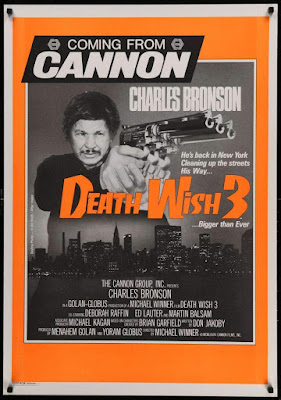
“Death Wish 3” is a 1985 action thriller film starring Charles Bronson as grieving husband turned Rambo-like vigilante Paul Kersey. I’ve had a DVD copy of it on my chair to watch for some time now. In fact, there are two copies – it was so cheap second-hand that I didn’t realise I ordered two copies by accident.

I am used to dissecting films both here and in my education, and the act of looking for something to learn, or to redeem, from any film I watch, means I must have developed a higher tolerance for what the casual viewer would otherwise call crap. I am not going to say that of “Death Wish 3”: it’s competent, it’s serviceable, it’s under an hour and a half, and I watched it until the end. It’s a Cannon Group film from the 1980s, and that was all that was expected of it at the time – it was, at least, better than their film “America 3000” from the following year, which I have reviewed previously [link].

The reason I bought this film was hearing that, to make savings in the budget, a derelict hospital in the Lambeth area of London substituted for the New York projects. It works well enough, but only if you remember to look past that fact afterwards, just like seeing the respected actor and director Alex Winter – Bill, of Bill & Ted – playing a thug. Other than that, Cannon films were very much of their time: its ownership under producers Menahem Golan and Yoram Globus spanned the 1980s, and the lower-budgeted action-led films they are most identified by exist purely to thrill their audience. Their business model was to sell the film to distributors first, then use that money to make the film – delivering maximum bang for their buck was where the profit arrived.

Having said that, thinking about “Death Wish 3” is probably not what Cannon wanted me to do. The violence is glorified, and Paul Kersey is celebrated for his kills, and it is all sanctioned by the plot, Kersey having been given free rein by the police commissioner in the first act. The film is very fast, its story having been set up within the first fifteen minutes, and every scene feels like it was once longer, but then pared down to the bone by editor Arnold Crust, a pseudonym for director Michael Winner. The gang of thugs in this film feel like the most cartoonish pack of rats that could have been written – they only look like people, and having no motivation to write them like people makes Kersey blowing them away that much easier to cheer, if you find yourself doing that. Don Jakoby objected to the rewrites of his script, his name in the credit replaced by “Michael Edmonds”. 

The final ten minutes is one explosion after another, until the gang finally retreats after they see what we assume to be the burning corpse of their leader. The police commander tells Kersey he should go, buying him a few minutes – the credits roll fifteen seconds later, the music starting like the theme from “Seinfeld” later sounded. Wasn’t that show also about “no hugs, no learning”?

Perhaps the easiest gauge of “Death Wish 3” is to look up the sequel from 1987, “Death Wish 4: The Crackdown”. Without watching it, I imagine the same action formula would have been followed, but because Cannon had overspent on prestige productions that did poorly at the box office, like Franco Zeffirelli’s “Otello” (1986), so future productions would be limited to budgets of $5 million, half the budget of “Death Wish 3”. Cannon could afford Led Zeppelin’s Jimmy Page to write and perform the music for “Death Wish II”, then have Mike Moran re-record it with synthesisers for the next one, but the fourth film is down to mostly reusing recordings from previous Cannon productions. Remember, Cannon also slashed the budget for “Superman IV: The Quest for Peace” around this time, which I have also talked about [link].

I was about to write if there was anything I should take away from “Death Wish 3”, but its objective was solely to entertain me. I was diverted, so we’ll call it a score draw.

28 April 2017

BUT HERE’S THE ONE THAT’S DRIVING ME BERSERK [52]


Earlier this week, I was told that I reminded someone of the character Sheldon Cooper, from the sitcom “The Big Bang Theory.” I said I have only seen the show a few times, but I had seen enough to know that wasn’t quite a compliment. There is a huge difference between knowing a lot and being smart, and I know I have, at least, some social skills, as I had to have a conversation with someone for this stink-bomb of information to come up.
However, the character, and the show, is successful because we can see ourselves (and others) in it, and because that identification makes us laugh – entering “The Big Bang Theory” into an internet search engine now brings up the show before the actual theory. While I am not a fan, I am aware that making a show about people previously described as “nerds” and “geeks” into a worldwide hit is simple: compare the type of people most of us don’t know, with those we do. Add in the usual American sitcom production line, writers’ room, big-budget salaries and promotion, and it continues to work – if “nerd culture” is now cool, it’s because the most popular sitcom is full of them.
In the UK, we have a dearth of sitcoms – if we had a golden age, it was probably over by the turn of the century. Dramas are the narrative order of the day on primetime TV, from multiple episodes of soap operas to sumptuous feature-length stories. If you can work in a bit of humour, fine, but nothing that will alienate too many people: ITV’s current sitcoms “Benidorm” and “Birds of a Feather” are, for me, a bit too broad in humour, but while “Birds of a Feather” is your standard three-set, three-character set-up, in front of a studio audience, “Benidorm” is an hour-long serial with multiple characters coming in and out, just like the dramas they also show, because it is what works most often for them.

With the potential of any story to become a drama, especially when they are usually an hour long on television, the half-hour standard for sitcoms usually mean generalising – shorter, quicker stories, dropped in and wrapped up in a flash, with a moral to take away at the end. Characters can be generalised, as I managed with “The Big Bang Theory.” To cap it all, if your comedy is not to everyone’s taste, or too broad, or too obscure, or not explained properly, few people will be interested in watching again – better to be safe with a drama, where you can concentrate on just the story. “Till Death Us Do Part,” remade in the US as “All in the Family,” could easily have been a kitchen-sink drama of a patriarch spouting his racist, sexist, xenophobic views over his family but, in inviting the audience to laugh at Alf Garnett, some found a friend, instead of an enemy, and the context became lost – in “All in the Family,” Archie Bunker, unlike Garnett, became mellower as time went on.
For the record, my favourite sitcom is an American one, “Seinfeld,” eschewing conventions by having bizarre, inconsequential storylines, characters that varied from strange to downright monstrous, and “no hugs, no learning.” It is considered to be the best of them all, continuously shown and studied twenty years after it ended, but when the best has already been made, what do you do now?
Time for me to write that script about a researcher…