Showing posts with label Tomorrow's World. Show all posts

07 February 2021

MAYBE TOMORROW I’LL FIND MY WAY HOME [281]


I have two reasons why I believe the idea of “the future” ended in 2003.

Firstly, Concorde was withdrawn from operation by British Airways and Air France. Supersonic passenger air travel has been a thing of the past for almost twenty years.

Secondly, the BBC cancelled “Tomorrow’s World,” a science and technology series that went out in prime-time, for a mass audience, demonstrating innovations from computers and the CD player, to the breathalyser and bulletproof vests.

You may argue that neither of these stayed viable – a downturn in air traffic following the 2001 terrorist attack on New York, and a change in demands of “luxury” air travel the Concorde could not be modified to meet; or a downturn in the ratings of “Tomorrow’s World,” along with new technology being incorporated into the BBC News show “Click,” formerly named “Click Online”.

Both have joined the museum of what was considered “the future” – an example of Concorde can be found at the Intrepid Sea, Air & Space Museum, alongside the Space Shuttle Enterprise; and “Tomorrow’s World” lives on as an archive used to mark where progress has previously been made.

Postmodernism does not aspire to the same earnest drive for progress that characterises modernism. Postmodernism is more concerned with how we see the world, and while its characteristics of fragmentation, collage and nostalgia do not require new material, anything that does come along will simply be added into the mix. Innovations may come, or refinements can be made, but there is nothing to suggest that the world of 2050 will be as radically different to that of 2021. “The Jetsons” was set a hundred years from when it was made, but as I sit in 2021, I don’t see flying cars and cities in the sky becoming commonplace in the remaining forty-one years left, although the robot maid could be a close-run thing.

However, I do not believe the de-emphasis of progress can be blamed on postmodernism. A kind of contentedness arrived in the Western world after postmodernism became part of the cultural background. Francis Fukuyama’s 1992 book “The End of History and the Last Man” hypothesised that the end of the Cold War in the previous year meant that liberal democracy had effectively won, and while events still occur, the progressive procession of “history” has ended. Meanwhile, “capitalist realism,” as popularised by Mark Fisher in his 2009 book of that name, takes a German term originally describing commodity-based art, redefining it as the notion that corporate capitalism and neoliberalism are now so dominant, there is no visible alternative to them. While it might not have been the kind of future we envisaged, it may well be the one we were destined to have.

This tends to be characterised by overt recycling in popular culture. For example, the music instrument manufacturer Roland sells a drum machine, the TR-8S, that for all the advanced programming and sampling features included, exists mainly as a new version of their original 1980s drum machines like the TR-808 and TR-909, working in similar ways to achieve the same effect, because music from the 1980s and 90s remain popular. I cannot honestly say what popular music will sound like ten years from now, because it endlessly refers to itself, perhaps from the moment Jackie Wilson’s “Reet Petite” became the UK Christmas number 1 single in 1986.

This may be the sort of conclusion that would still be made before the year 2020 began, as the emergency caused by Covid-19 accelerated the advent of human behaviour we still thought would be more commonplace in the future: working from home, communicating by video calls, the hastened end of brick-and-mortar retail. New medical innovations in vaccinations and personal protective equipment may be one thing, but these are innovations we needed and expected to occur. Envisaging a future of flying cars and unlimited leisure involves an element of force to enact the change, closing the gap between reality and the imagination.
02 June 2019

BUT I’M NOT LETTING YOU OUT OF MY SIGHT [178]


Never underestimate the toughness of a Compact Disc. I’m not talking about the episode of “Tomorrow’s World” where one still plays after Kieran Prendiville smeared jam on it, because that never happened – a report on the BBC’s “Breakfast Time” showed someone doing that with honey, while Prendiville was presumably safe at home in bed.
What I am talking about is owning a CD playing as perfectly as when it was pressed in 1987, a testament to the error-correction technology built into CD players as long as forty years ago, and the record company printing instructions on how to care for it inside the cover.  
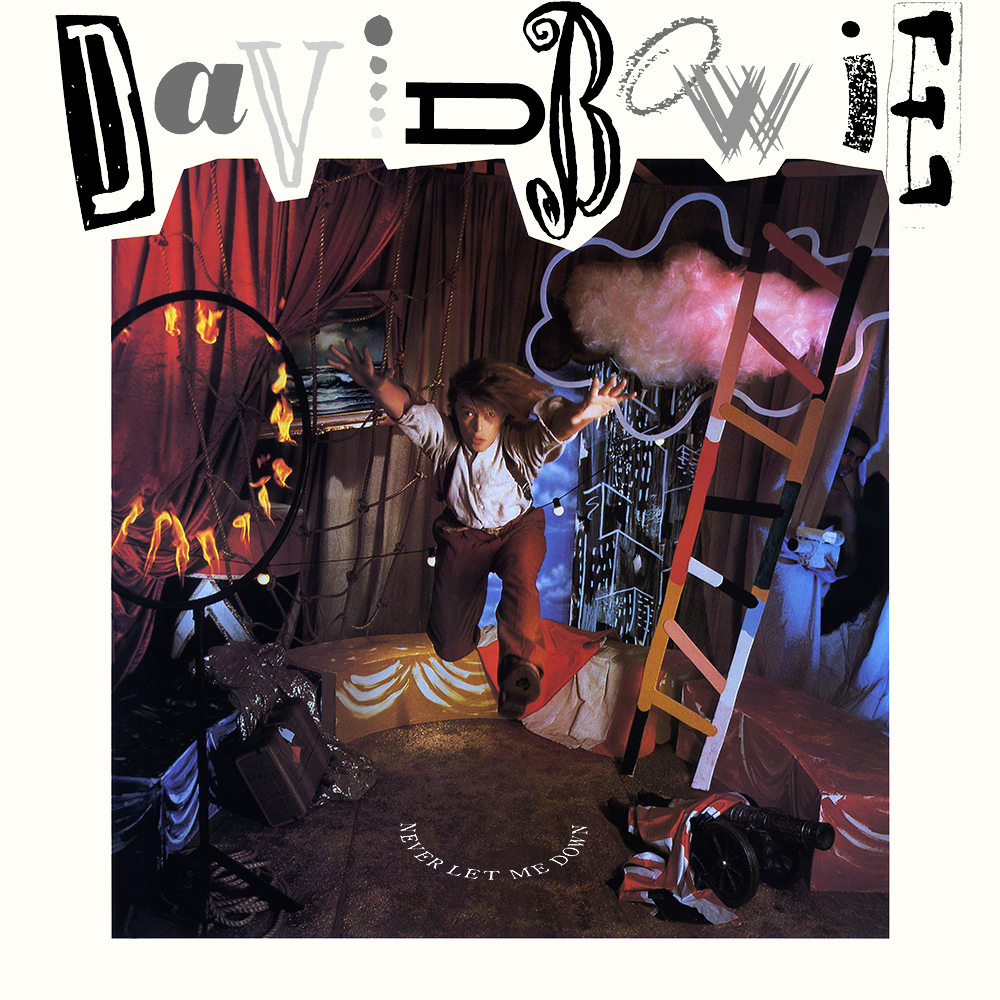
Why do I have a CD as old as this? It is because David Bowie disliked a song on one of his albums so much, it was deleted from all future releases of it, even after his death. Its only other release was a rare promo record in the US, before the record label decided not to release it as a single. 
The song is named “Too Dizzy,” and I quite like it.
When David Bowie released "Never Let Me Down” in 1987, it became one of his biggest-selling albums. Having scored a phenomenal hit with the “Let’s Dance” album, resulting in a scramble for bigger stadiums than usual to play the Serious Moonlight tour, “Never Let Me Down” needed to play to a much wider, much broader audience than would have taken in Major Tom, Ziggy Stardust, and the Thin White Duke.


However, “Never Let Me Down” became one of David Bowie’s least regarded albums, particularly by Bowie himself, who described playing to the broader crowd in the 1980s as his "art-school Phil Collins" period: if the audience should be at a Phil Collins gig, then what was he doing? Like “Let’s Dance,” and 1984’s “Tonight” album, “Never Let Me Down” is less the work of “David Bowie,” which remained a stage name throughout his life, but more the fit, healthy and perfect David Jones, about to get his teeth fixed.

"Never Let Me Down" is the most commercial album David Bowie ever released, in that its polished, smoother sound could have come from other 1980s artists. Its synthesised sound dates the songs, and is reminiscent of Bruce Springsteen's "Born in the USA" album – “Beat of Your Drum” sounds close to “Glory Days.” Lyrics are concerned about social problems - "Day-In Day-Out" talks about poverty, while "Time Will Crawl" deals with ecology and nuclear paranoia after the Chernobyl disaster. Oh, and the actor Mickey Rourke does a rap on one song too - on a David Bowie album...
If anything, "Too Dizzy" is a welcome breeze, following the statement on Margaret Thatcher that was “87 & Cry.” A very upbeat song about 1950s teenage jealousy, and apparently a throwaway song written to see how Bowie worked with instrumentalist Erdal Kizilcay, “Too Dizzy” could either be seen as a breather from the socially aware songs on the album, or a distraction from them – that Bowie was surprised he left it on the album suggests the latter.

With a sound that demands to be played on big speakers as loud as possible, ”Never Let Me Down” feels good on the surface, and is worth a listen in the mood for a hard slap of Eighties, but it doesn’t feel like a David Bowie album. Bowie had always intended to re-record the album at some point, and the group that did so in 2018, for the “Loving the Alien” box set, had been chosen by Bowie before his death. The new version of the album sounds more stripped back and folk-like, more strings and brass in place of synthesisers, which mostly benefitted “Zeroes,” a song about the music of the late 1960s – you can hear the Mellotron now. However, Erdal Kizilcay has been left out of the album entirely, including “Too Dizzy,” and was considering a lawsuit if his arrangements were used without credit or compensation.
Would “Too Dizzy” have fitted among the re-recorded version of “Never Let Me Down”? It has a very peppy sound, with lots of saxophone, so making any change to that would be reductive, even if it would make it fit more with the rest of the album. Perhaps the song could be released as a separate song, but to prevent its release in any form just seems strange.
For me, there does come a point where, if you have put something out into the world, then change your mind on how you think about it, you can't then decide it didn't happen, especially when it really isn't that bad. No wonder Bowie finished the 1980s by submerging his ego in the hard rock of Tin Machine for a while.
I still love David Bowie and his songs, but rock gods are not infallible.

10 September 2018

WE’VE JUST BEGUN TO DREAM [126]


The Walt Disney World Resort is almost its own entertainment nation state, made up of theme parks instead of cities. At thirty-nine square miles, it is the size of the Caribbean island of Montserrat, or slightly bigger than Jersey.
Its second theme park, Epcot, opened in 1982 as a celebration of human endeavour, a kind of answer to how the Magic Kingdom came to be. Building from Walt Disney’s original idea for the Experimental Prototype Community of Tomorrow, where traffic would travel in tunnels under a lush garden city, the “EPCOT Center,” to use its original name, would combine two further theme park concepts, one of technology and another of international cultures, into what was often labelled a permanent World’s Fair. Disney’s involvement in the 1964/65 New York World’s Fair is a precursor to Epcot, where its attractions “It’s a Small World” and the “Carousel of Progress” would be relocated to Disneyland after the fair ended, while Disney’s first full animatronic display, “Great Moments with Mr. Lincoln” would be reworked as Disneyland’s Hall of Presidents.
I would have loved to have seen the original EPCOT Center, having become aware of it – when it opened, the future was coming thick and fast, with the advent of home computers and compact discs, while British TV audiences still had its own primetime showcase for new technology in “Tomorrow’s World,” coming live from the site of the 1908 Franco-British Exhibition, proving that, in building BBC Television Centre on the land, you should still look to the future as much as you can.

Like the World’s Fair, Epcot would use corporate sponsorship to maintain and develop the rides – World in Motion, now Test Track, has always been sponsored by General Motors, now using the Chevrolet brand, while the Universe of Energy was sponsored by oil company Exxon, now ExxonMobil. However, this model has its problems: Horizons, the ride that specifically looked towards the future, lost General Electric as its sponsor in 1994, and carried on until 2004 without ever having been updated in twenty years.

The worst example of this was how Journey Into Imagination, sponsored by Kodak, went from being Epcot’s most popular ride to its most reviled, with Kodak’s reluctance, and later inability, to spend too much on updates, resulting in a cheaper ride that had its length cut from thirteen to five minutes. When the ride’s original mascot, Figment, was brought back to irritate the shorter version’s host, Eric Idle, it smacked of a lack of imagination, especially as the ride has not been updated since 2002.

These days, Epcot rarely has sponsors, the united nations of the World Showcase have been somewhat undermined by the Trumpery of “America First,” the health-oriented Wonders of Life pavilion is now the centre of the International Food & Wine Festival, while Innoventions, a technology showcase formerly named Communicorp, is mostly empty. The current edutainment-led rides at Epcot, already using some familiar Disney properties like Finding Nemo and Frozen, will be joined with rides fully based on them, with a “Guardians of the Galaxy” rollercoaster replacing the Universe of Energy from 2021 – there had already been a plan to supplant the idea of a “FutureWorld” with a more thrill-based “Discoveryland,” and it sounds like it is now on its way.


Is the future over? Even if I am no longer able to visit the future, as seen from 1982, I would have loved to have visited an Epcot that ran with the future theme all the way, visiting a pavilion titled “The Wonderful World of Graphene,” displaying roll-up computers with antiseptic surfaces, or something. Meanwhile, I could be fired like a proton through a virtual Large Hadron Collider, much like you can take a rocket to Mars on the current Mission: Space ride.

Mind you, as we hark back to the 1980s... and as “Guardians of the Galaxy” harks back to the 1980s... and as BBC Television Centre is redeveloped as apartments, using its history as a TV studio as a selling point, I am left with the ghost of a theme park I can never visit. At Epcot, the future has been cancelled.