
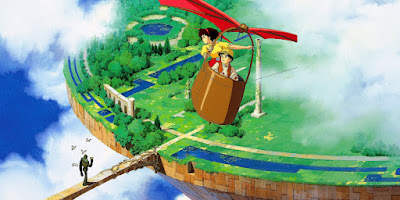
It is a fact of 1990s family life that some VHS cassettes were repeatedly watched until the tape wore out. My family had many: “Who Framed Roger Rabbit?”, “Back to the Future”, and “Fantasia”. All would be replaced as time and home video formats progressed, but one tape, which became lost within the family home, could not be replaced until the film’s eventual DVD release in 2006.
It turned out our lost copy of what was being called “Laputa the Flying Castle,” recorded from a TV airing on 31st December 1988, was from the first occasion that a Japanese animated feature film had been shown on British television. That this was shown at 9.25am on the populist ITV network, more known for cramming their Christmas schedules with Star Wars, Harry Potter and James Bond, is even more remarkable. If they ever did it again, I am not aware of it.
A story of mystical cities, escaping kidnap and airborne pirates, “Castle in the Sky” was directed by Hayao Miyazaki and released, in 1986, as the official first film from Studio Ghibli, founded on the success of “Nausicaä of the Valley of the Wind” two years earlier. Like much of Miyazaki’s work involving planes, airships and other flying devices, “Castle in the Sky” has become widely influential as a classic of the steampunk genre.
The flying island itself is lifted in name and concept from Jonathan Swift's novel "Gulliver's Travels," while also influencing the plot of wanting to harness the castle for political, nefarious ends, before ultimately crashing to the ground. Unlike Swift's satire, Miyazaki's Laputa was old technology and reason, overgrown and reclaimed by nature, to be left alone - it is allowed to escape at the end, but irreversibly marked by human hands.
The setting of a small mining town was familiar to British audiences. Miyazaki visited Wales in 1984 as part of the film’s research, and his witnessing of the aftermath of the Miner's Strike influenced characters as well as architecture. A later noted steampunk work, 2004’s “Steamboy”, Katushiro Otomo's eventual follow-up to "Akira," was explicitly set in Victorian industrial Manchester. “Castle in the Sky” would later be shown in Aberystwyth in 2011, a charity screening to support relief efforts following the Tōhoku earthquake and tsunami, using its original Japanese soundtrack.
Despite The Walt Disney Company’s release of Studio Ghibli’s films on DVD, our lost copy of the ITV airing of “Castle in the Sky” would not truly be replaced until around 2018, my sister having sourced a copy of the Japanese DVD version originally released in 2002 – I immediately asked her to order another one for me. This was the only place we could find the English dubbed soundtrack prepared by Magnum Video Tape and Dubbing, for use in Japan Airways trans-Pacific flights, and later in American art-house screenings – it is a straight translation of the original Japanese, with music and sound effects left intact. Pazu, the boy who rescues central figure Sheeta from kidnap, is voiced by Barbara Goodson, now best known as Rita Repulsa from “Power Rangers”, while Sheeta, who possesses a magical crystal of the sort that allowed the city of Laputa to fly, is voiced by Lara Cody, who later dubbed voices for English-language versions of “My Neighbour Totoro” and “Kiki’s Delivery Service”. This was the version I remembered from my childhood, even if it is not the film’s own original soundtrack, but I knew I had the correct version the moment I heard Pazu deliver a lunch at work: “meatballs for the boss.” As Proustian as a madeleine biscuit, I’m sure you will agree.
It was important for me to have the version of “Castle in the Sky” that I remember, because that version was the reason one of my formative experiences of watching a film – I was five years old when ITV broadcast it – has led me to be spoiled when it comes to the expectation of what an animated feature film can accomplish in scope of story, technical detail and emotion. Arguably, only Studio Ghibli have matched it since, and only Pixar have come close.
It is already noted that the English-language dub of “Castle in the Sky” now most widely available, recorded by Disney in 1998, took liberties with the soundtrack that were later revised and scaled back on further home video releases. The original sixty minutes of synthesised musical score, reworked by the original composer Joe Hisaishi into a lavish, and overwhelming, ninety-minute orchestral performance, was restored, as were periods of silence that were filled in with background noise. However, the increase in Pazu and Sheeta’s ages, from pre-teen to mid-teen, and lines that made Sheeta a potential romantic interest to the airborne pirates instead of a mother figure, were retained, perhaps because James Van Der Beek and Anna Paquin would have had to be recast. The original changes were authorised by Studio Ghibli, but with this now also being the English-language track on Japanese DVDs, following a re-release in 2014, it leaves only the original Japanese soundtrack as being the “correct” version available. Perhaps this is how it always should have been, but accessibility doesn’t usually require a rewrite.


