Showing posts with label Human League. Show all posts

06 September 2020

WHO DO YOU LOVE? IS IT ME BABE? IS IT HIM NOW? [259]


With my tastes in music saturated with synthesisers, Eric Clapton rarely makes my playlist, but I always make an exception for “Behind the Mask,” released in 1987. It is a rare Clapton song where the main drive is the synth chords and powerful drums, his own guitar playing used for extra flourish here, but the production is tight, and the call-and-response chorus, with the backing singers seemingly the ones in charge, is immensely effective.

I had never questioned where “Behind the Mask” came from, letting it stand by itself, but having stumbled across its origin, I am not only far more informed, I have a new favourite version of it too.

Two weeks ago, the YouTube algorithm suggested I listen to “Rydeen,” by the Japanese electronic group Yellow Magic Orchestra, itself sounding like a splinter group of the Electric Light Orchestra. I was already listening to music from a different Japanese group, the jazz fusion band Casiopea –in particular the tracks “Space Road,” “Midnight Rendezvous” and “Swallow,” all from their 1979 debut album, practically inspiring computer game music for the following decade – but “Rydeen” came up after its use in a different video I had watched. Yellow Magic Orchestra were influenced by Kraftwerk and Giorgio Moroder, but their use of synthesisers, sequencers and drum machines as a mainstream pop group at this still-early stage predated the development of synth pop and techno music in the 1980s.

Their eponymous first album, from 1978, sold well in the United States, but their second, 1979’s “Solid State Survivor,” on which “Rydeen” is found, sold two million copies worldwide. In Japan, “YMO” were as popular as when Beatlemania hit the US in the 1960s, even though they initially started as a joke band satirising Western ideas of “exotic,” “Oriental” Japanese music – a sarcastic cover of Martin Denny’s “Firecracker” ironically became a major hit in its own right, reaching number 60 in the US Billboard singles chart, and number 17 in the UK chart, before sampled by everyone from Afrika Bambaataa and 808 State to De La Soul and Jennifer Lopez (for the song “I’m Real”).


Naturally, I ordered a copy of “Solid State Survivor,” and have been obsessed with “Technopolis” and “Absolute Ego Dance,” but noticed it also had a track titled “Behind the Mask.” It could be a different song – Fleetwood Mac released a song and album named “Behind the Mask” in 1990 – but when I heard it begin, it sounded like a simpler, electronic version, with only one side of the chorus sung, using a vocoder. Like the version of The Beatles’ “Day Tripper” on the album, until I realised the dates didn’t match up.

The basic structure and melody of “Behind the Mask” was written in 1978 by YMO member Ryuichi Sakamoto for a TV commercial, advertising Seiko watches. (I was unable to find the original ad for myself, as searching “1978 Japan Seiko watch commercial” only brings up a separate ad starring Kate Bush, the watches intercut with her dancing and singing of “Them Heavy People”.) This was developed into a full song after YMO was formed, with the British lyricist Chris Mosdell adding verses inspired by Japanese Noh masks, and by the W.B. Yeats poem “The Mask”. Mosdell has talked about the lyrics representing a society that is very impersonal and controlled, with the immobile mask presenting a cold, unemotional state, but Japanese Noh theatre itself relies on codified gesture and expression, the traditional masks presenting different moods depending on how they are tilted.

(I must mention at this point that the Ryuichi Sakamoto I mentioned above is the same one that, as an actor, appeared alongside David Bowie and Tom Conti in the film “Merry Christmas Mr. Lawrence,” in addition to writing its score – he also wrote the music for “The Revenant” and “The Last Emperor,” for which he won an Academy Award.)

The YMO version of “Behind the Mask” was released as a single in the UK in 1980, and was included on the US and European version of “×∞Multiplies,” released there as the second YMO album instead of “Solid State Survivor.” Record producer Quincy Jones heard it, and shared it with the singer whose next album he was producing. In an alternate world, “Behind the Mask” would have been a song on Michael Jackson’s “Thriller,” the biggest-selling album of all time, and one of the most culturally-significant albums ever made, but a failure to agree over royalties, prompted by the extra lyrics and melody written by Jackson meant it was not included.


The Jackson lyrics turn what was a meditation on emotion – “Is it me, is it you / Behind this mask, I ask / Is it me, is it you / Who wears another face” – into a storyline about someone spurned by a duplicitous lover, hiding behind a mask, with lines like, “sit behind the mask where you control your world,” and “camouflage the truth, indulge your fantasy.” The second verse of Mosdell’s lyrics are adapted into a chorus that makes clear how the meaning has been changed:

Mosdell version: “There is nothing in your eyes / That marks where you cried / All is blank, all is blind / Dead inside, the inner mind”

Jackson version: “There is nothing in your eyes, that's the way you cry, girl / All is grand, all is bright, you're just studying my mind”

It is clear that the disagreement over the Jackson version was purely contractual: Ryuichi Sakamoto released his own version in 1987, with Jackson’s lyrics sung by Bernard Fowler, in an arrangement ironically rockier sounding than Eric Clapton’s version. Jackson had recorded his lyrics, remaining unreleased until 2010’s posthumous album “Michael,” where a new arrangement of the music, mixing in YMO’s original version, was overlaid with the original 1982 track.

The nearest we have to what the original Jackson version could have sounded like is found on the 1984 album “Pulse” by Greg Phillinganes, a musician that has performed with Stevie Wonder, Laura Brannigan, Bruno Mars, George Benson, Kenny Loggins, and Michael Jackson and The Jacksons, working with them on every album from 1978 onwards, the highlight of which was creating every keyboard part on the song “Thriller,” from the opening chords, the base lines, and the pipe organ accompanying Vincent Price. Phillinganes affects a couple of Jackson’s signature sounds, but his playing skills is reflected in what is still an entirely electronic score, singing against a vocoder in the chorus.


Greg Phillinganes also plays keyboards on Eric Clapton’s version of “Behind the Mask,” having introduced the song to him, although you can hear more “real” sounds – the vocoder has been replaced with backing singers, one of which is the song’s producer Phil Collins, whose tight drumming is essentially replicating a programmed machine. As mentioned, this version remains led by synthesisers, whereas the Ryuichi Sakamoto / Bernard Fowler version relegates them to playing background chords behind a fuzzy guitar lead. Sakamoto would make a further version with Yellow Magic Orchestra, again using Jackson’s lyrics, this time sung by a UK electro-pop group, and released on a 1993 EP titled “YMO Versus The Human League”. This time around, it sounds like a standard UK dance song from 1993, and even though YMO were involved, there is nothing in the recording to distinguish it from a Human League song of the time, especially when you compare it to their later hit “Tell Me When”.

Of the seven versions of “Behind the Mask” I have now heard, picking a favourite involves splitting it two ways: the original Yellow Magic Orchestra version from “Solid State Survivor,” is the best of all, and Greg Phillinganes’ version is the best that uses Michael Jackson’s additional lyrics, because it is closer musically to the YMO original. Even better, Yellow Magic Orchestra has emerged as a favourite band with me, although their version of Archie Bell & The Drells’ “Tighten Up,” retitled “Tighten Up (Japanese Gentlemen Stand Up Please!)” is a bit of an acquired taste.
28 January 2018

IT’S A GAME OF GIVE AND TAKE [93]


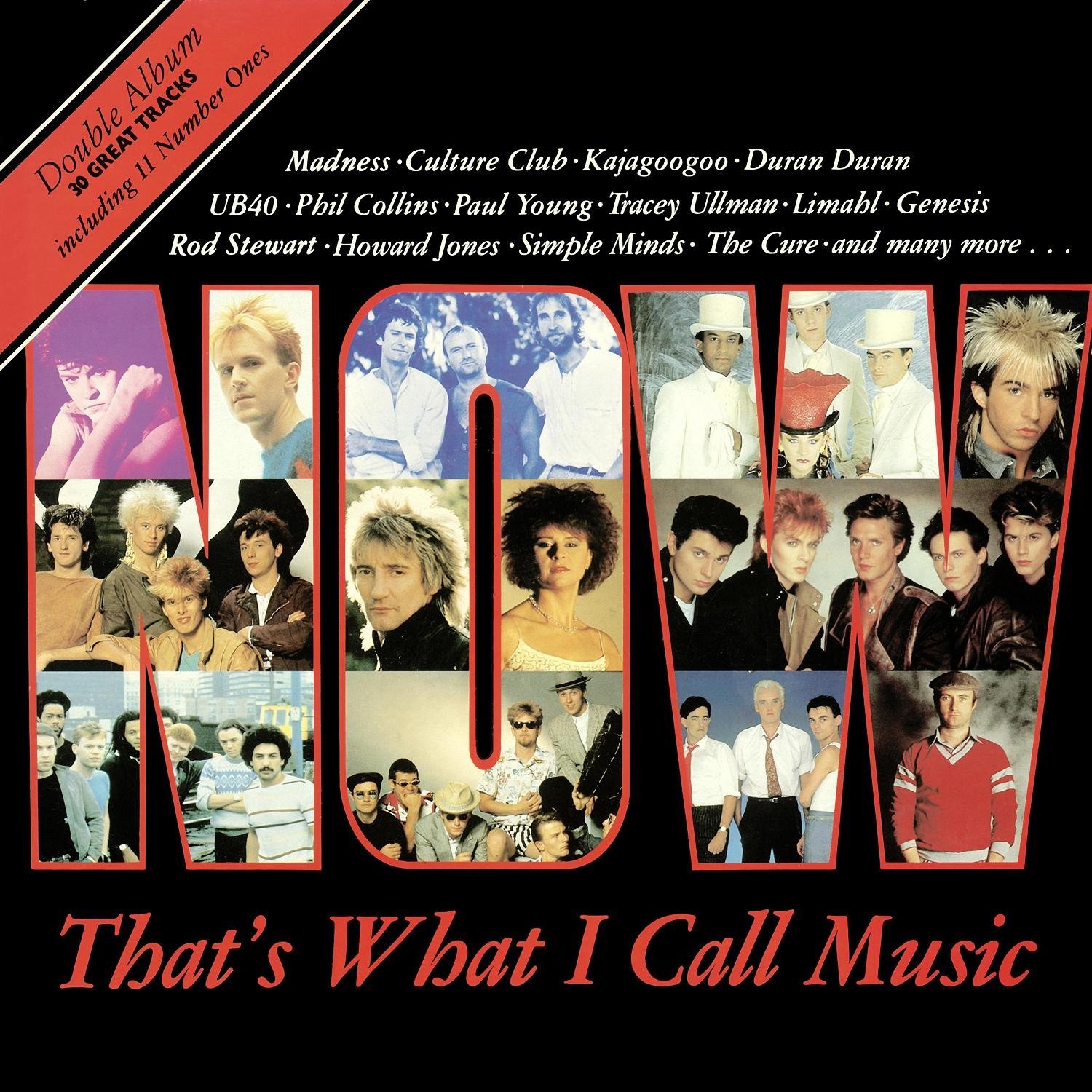
Walking around an antiques store in a nearby village, I came across a selection of vinyl records and magazines. At the top of the display were old 1980s copies of “NME” magazine, still billed as “New Musical Express” on the cover. Working my way down, expecting another magazine, I struck gold: from 1983, I found the original “Now That’s What I call Music” album.
The “Various Artists” compilation album was the preserve of cheaper labels like K-Tel or Ronco, or for when a record label wanted to round up the best of its own releases, like the “Motown Chartbusters” series. Instead, “Now” was the first collaboration between two labels, the biggest in the UK: Virgin Records, which originated the idea, and EMI, which also pressed and printed the records. If you bought “Now” when it came out on 28th November 1983 – it eventually spent five weeks at number 1 in the charts – chances are you went to either EMI’s record chain, HMV, or to Virgin Megastore.
The name “Now That’s What I Call Music” came from an unlikely source, and one I thought had been randomly stuck to the back of the album sleeve: Richard Branson, Virgin’s founder, knew his cousin Simon Draper, managing director of Virgin Records, was grumpy before breakfast, and loved to have eggs in the morning, leading to Branson hanging a 1920s poster, used to advertise Danish bacon, behind Draper’s desk: under the caption, “Now, that’s what I call music,” a pig leans on a wall, listening to a clucking chicken, an egg lying in front of them. After listing the music labels that assisted Virgin and EMI – CBS, Epic, Charisma, Polygram, Capitol and so on – the kind permission is noted of Danish Agricultural Produces in allowing the poster to be used. The pig acted as a mascot for the following four albums.

The first “Now” album has thirty songs, arranged roughly in order of release date, eleven of which (mostly from EMI) reached number 1 when released as singles – a note in the gatefold lists the only five other songs to reach the top of the charts in 1983. In some cases, like Madness’s “The Sun and the Rain,” you are told it had reached number 9 when the compilation was released, and “Victims,” by Culture Club is listed as, “almost certain No. 1 by the time you have this LP” – I am not planning to overwrite the “1” with a “3”. However, the album is redeemed by another choice, “just released at time of compilation,” which was “destined to be a smash hit” – “Let’s Stay Together” proved to be Tina Turner’s biggest hit to date.

A wide range of musical styles are found on the album, ranging from New Romantic bands like Duran Duran, Human League and Culture Club, the big influencers at the time, to R&B, soul and rock groups, all down to including the hits – Bonnie Tyler’s “Total Eclipse of the Heart,” “Wherever I Lay My Hat” by Paul Young, “Down Under” by Men at Work, and New Edition’s “Candy Girl” are all here. A 2015 scientific study, by Queen Mary University London and Imperial College London, of 17,000 pop songs revealed that 1983 was an epochal year, as synth-based music became big in the United States, led by a procession of British bands – in the same year, both Eurythmics and Dexys Midnight Runners would have US number 1 songs. However, the same study also found that the accompanying drum machines and sampling led to more songs sounding similar by 1986, before hip-hop broke through by 1991.
Some bands, or lead singers, do rather well on this album. In addition to “Victims,” Culture Club also feature with “Karma Chameleon,” the biggest-selling song of the year. UB40 also have two songs, “Please Don’t Make Me Cry” and “Red Red Wine.”  Genesis features with “That’s All,” but a solo Phil Collins had the first number 1 of 1983, “You Can’t Hurry Love.” (Phil Collins also features twice on the front cover – once with Genesis, and once by himself.) However, “Now” had more faith in Kajagoogoo than most, including not just “Too Shy” and “Big Apple,” but also Limahl’s solo single, “Only For Love” – the band broke up in 1985, having already fired Limahl earlier in 1983, but have since reformed.

Out of thirty singles, only seven come from artists outside the UK – apart from Tina Turner, you get Rock Steady Crew, with that one hit they had; “Safety Dance,” by the Canadian band Men Without Hats; and “Kissing with Confidence,” a disco novelty song, based around self-help guides, by “Will Powers,” with lyrics by an uncredited Carly Simon, who is pictured in the album with hand on hip, waiting for herself to write “Coming Around Again” and “Let the River Run.” The current Ofcom license for BBC Radios 1 and 2, the biggest stations in the UK, require 45% of the songs they play to come from UK artists, so seven songs out of thirty may have just been down to the available space on the records.

I do have a record player, and “Now” sounded exactly as I expected – a bit quiet. The premium, heavier, 180-gram vinyl found more often today means you can cut deeper grooves into your record, allowing for a louder sound, and reduced surface noise. However, these records weigh 130g each, and in jamming up to eight songs onto each side, the grooves have to be packed more tightly, and cannot cut too deeply. Strangely enough, the first “Now” album I ever bought, 1996’s “Now 35,” turned out to be the last released on vinyl – cassette sales ended with “Now 63” in 2006, digital downloads having started one album previously.

“Now 100” will be released around July 2018, cementing the series’ reputation as the hits compilation of record for the British charts, far outliving the labels that started it – EMI bought Virgin Records in 1992, but Universal Music, which joined the “Now” group in 1990, after ending their own competing series, bought EMI in 2013, with its music publishing arm being snapped up by Sony. Universal and Sony now run the show together, but give it another thirty years, and we may be saying something else again.