Showing posts with label Prime Minister. Show all posts

24 November 2024

I’LL CALL YOU JAGUAR IF I MAY BE SO BOLD [476]


Creativity doesn’t have to make sense to you personally, even in advertising. Far be it from me to defend the decisions of a multi-national car manufacturer, but belittling creativity is something I will not have.

On Tuesday 19th November, Jaguar Cars unveiled a thirty-second advertisement featuring a group of colourfully-dressed individuals arrive on an equally colourful, but rocky landscape. They look around, then look at you. One paints lines with a paintbrush, and another brandishes a sledgehammer. Two-word slogans fill the screen: “create exuberant”, “live livid”, “delete ordinary”, “break moulds” and, most importantly, “copy nothing”.

With no cars featured, this was instead a statement of intent by Jaguar ahead of the announcement of a new electric-only car range on Monday 2nd December. Regardlessly, it was met with knee-jerk derision by commentators and social media accounts, using the ad as a vehicle for their existing prejudices by accusing Jaguar of junking their heritage to embrace diversity and “wokeness”, as if they were trying to make more of a point beyond the slogans in the ad, rendering anything not presented straightforwardly as being suspect. 

This invective felt like the inverse of the jokes I made in an article I wrote back in 2017, about the then-new Range Rover Velar helping people to identify and come out as Range Rover drivers: “I should be more open-minded and respectful about the life choices people make, and learn more about what leads to people wanting to drive a Range Rover. The more we know, the more the world can be a better place - so long as we don’t cut each other up.”

I was also unimpressed with the derision of Jaguar’s new image as having appeared from nowhere, as if years of preparation hadn’t been made in formulating Jaguar’s new approach – they are moving upmarket from making “executive” cars that competed with BMW and Audi, becoming a high-end brand alongside the likes of Bentley and Porsche – along with stopping production lines to retool their factories for the new range of cars, also the culmination of years of development.

Predictably, the aesthetic of the ad prompted people to ask if Jaguar had started making clothes, as if licensing deals between car and clothing manufacturers had ever existed, and others that included a direct competitor to Jaguar, Tesla’s Elon Musk, said “Don’t you sell cars?”, a reference to none being shown in the ad, to which Jaguar’s managing director Rawdon Glover said, “Yes. We’d love to show you”.

I had thought that people would have looked at the ad more closely, or looked more than once – it was only thirty seconds long. In two scenes, areas are painted over or illuminated with lines, a reference to the “strikethrough” imagery that forms both the new use of the Jaguar “prowler” logo – the main Jaguar logo is now just a sans-serif wordmark – and a design motif that will feature on the new range.

Despite the startling difference with Jaguar’s former establishment image – the Jaguar JX6 saloon was the British Prime Ministerial state car from 1979 to 2019, when Boris Johnson replaced it with a Range Rover – the ad was hardly the blindside to convention it has been made out to be. Those that remember a startling series of UK ads from 1995 that said only beautiful people drink Martini, depicting someone getting plastic surgery to comply,  will be aware of the disruptive tactics used by advertising agency Howell Henry Chaldecott Lury (HHCL), including the extraordinary Tango soft drink ads of the 1990s, and the launch of First Direct Bank in 1988 that “hijacked” ITV and Channel 4 simultaneously with a broadcast purportedly from the future. Jaguar needed people to start talking about Jaguar again before they could start talking about their cars, and couldn’t have achieved that aim more perfectly.

The slogan “copy nothing” comes from Jaguar’s founder, Sir William Lyons, who once said that “a Jaguar should be a copy of nothing”. He had a point. Walking down one street in my home town, not necessarily the most affluent but just above average, there were three Jaguars from the current model range, all of which have been withdrawn this year: an XE saloon, an XF saloon, and an F-Type coupĂ©. Only the Jaguar badge and grille distinguished them outwardly from the other cars in the street, all of which have the same raked, aerodynamic lines and pull-out door handles. Even worse, I passed an X-Type estate car, made during the period of Jaguar’s ownership by Ford, and based on the mass-market Ford Mondeo – you get the feeling the car should not have been allowed to happen.

When the notorious car conglomerate British Leyland was formed in 1968, merging the firm that owned Jaguar with the parent company of Rover, both names were used on cars that drove heads of state, not “executives”. This was rationalised to make Rover the more “affordable” brand, and perhaps the cars Jaguar had wound up making could, if it still existed, have been branded as Rovers – Jaguar’s current parent company, Jaguar Land Rover, have owned the Rover brand since 2008, but have seen no reason to use it so far.

Speaking of Land Rover, and any comparisons of the Jaguar ad to a clothes or perfume manufacturer are also a little ironic when you consider how the Range Rover, which has turned over time from a utility vehicle to a luxury SUV, once named its must luxurious trim level “Vogue”, after the magazine. This shift, alongside the shift in car buyers’ tastes towards sports utility vehicles, has directly benefitted Range Rover, perhaps at the expense of Jaguar, whose own SUVs were built on the same platforms as the Range Rover Evoque and Velar. In the current car climate, Range Rover effectively ate Jaguar’s lunch, hence the need to reposition themselves.

The new Jaguar cars – an XJ6-like saloon, a grand tourer coupĂ©, and a further SUV – will reportedly start from £100,000, which is the same as a large Range Rover, but a bit more than a Porsche. I don’t know why they didn’t just go with “POA” – “price on application” – because if you have to ask how much a luxury item costs, you can’t afford it anyway. That is the realm where Jaguar is destined or, for those that admire creativity without being able to drive, where it remains.

10 November 2024

TOO BUSY DODGING BETWEEN THE FLAK [474]


I had only one reason to think that Donald Trump could be re-elected President of the United States, and that was the event of his attempted assassination in Pennsylvania in July 2024, when the imagery of someone getting back up, punching the air as they were led away, eclipsed everything he had said or done, or could say and do. We live in the age of the moving image.

I have no intention of writing about Donald Trump again after this article, because I have done it more than enough times for one lifetime. I could find myself writing about the consequences of his actions, because you don’t have to be in the United States to have it act upon you in some way. Trump will do what he does, like he did last time, we will all resist again, like we did last time, and when he leaves office, because he cannot run for President again – and realistically will be too old to run for a third time, even if he somehow changed the rules – the next President will overwrite his proclamations with new ones, just like last time.

Meanwhile, most Americans that did vote for Trump may consider that choice to be as transactional as any other interaction he has made, because they cannot have voted based on character to have re-elected as known a quantity as him. Fears over the future of classical liberalism and democracy will fade, because people can still think, choose and act for themselves, regardless of what the rules are – how else does Trump think he can behave as he does? The search for a Democratic answer to this victory will be found, but by a younger generation of people.

It has already been noticed that sales of dystopian fiction, like “The Handmaid’s Tale” and “Nineteen Eighty-Four”, have surged in the days following the election. However, I had already thought about the fictional megacorporations that would have benefitted from a Trump presidency, like Wayland Utani (“Alien”), the Tyrell Corporation (“Blade Runner”) and Omni Consumer Products (“Robocop”). Elon Musk, having slotted himself into a prospective governmental position has also, through his use and misuse of his own social media platform, also fulfils the role previously filled by newspaper press barons like Rupert Murdoch and William Randolph Hearst. 

What am I going to do? I will leave below what I have already said before, leave it at that, and be thankful that the only reason the United Kingdom is on its sixth Prime Minister in a decade is because, when they are no good, either as a political leader or as a person, they are either voted out, or kicked out.

This could apply in so many cases, but in the next four years or less, read thoroughly, have a sense of history, and don’t repeat your mistakes.

Back when Trump was first elected in 2016, I said that “the weight of [the Presidential] office demands respect. However, the holder of that office cannot afford to be given the benefit of the doubt, especially when Trump has never appeared to need it before.” (“Who Says a Miss Was Made to Kiss?”, 21/11/2016)

In 2018, I mistakenly consoled myself knowing that 2025 could have been the latest possible year Trump could remain President: “What I do know is that everything will find its centre, or equilibrium once more, even if it has to make a new one, as people take stock of where everything has reached.” (“You’ll Never Live It Down Unless You Whip It”, 28/05/2018)

When Joe Biden was elected in 2020, I said that scrutiny of Trump will continue to intensify: “Trusting only his decisions, there is no history to learn, no precedent to observe, no dignity worth honouring... Perhaps your experience of life is tainted when the only people that come close to you will eventually sell you out for profit, but when you define your life by the deals you make, you can’t reasonably expect fealty from anyone.” (“Spank The Pank Who Try To Drive You Nuts”, 08/11/2020)

Finally, after the 2021 attack on the Capitol building, I thought I never had to consider Trump again: “Donald Trump became the de facto 'Gatekeepers' bogeyman: a man whose choppy utterances and half-formed, half-stolen slogans enraptured millions, and radicalised thousands more. Words were often beyond him, left to those in his administration to make sound reasonable, but the longer the noise, the threats against the media, and the pronouncements on Twitter went on, the more it became the stifling daily rhythm to everyday life... He really was the worst of us.” (“All About the Love Again”, 24/01/2021)

24 October 2022

AND IT’S NO GAME [367]


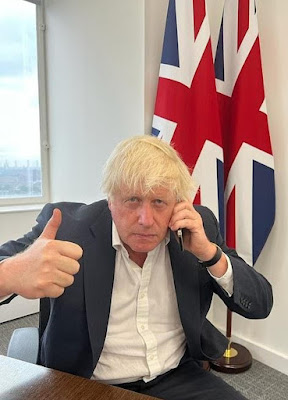
Official photo issued during Johnson campaign

The problem with writing about politics is that events often travel at break-neck speed, so I am not surprised at having eschewed politics as a subject for discussion at all. Give me postmodernism, pens and cars any day, along with any subject that remains evergreen, or slow-moving enough to pin down.

What rendered my previous article about the latest Conservative Party leadership election having been rendered out of date later the same day [link] was the announcement by one candidate that they were withdrawing from a race they never actually said they were standing in, like they had shown up to run the London Marathon with a hand-drawn number, withdrawing after realising whatever time they placed would never be counted.

The assumption made by Boris Johnson, returning from his holiday in the Dominican Republic to pick up from the point he had left in July, speaks of a man who hasn’t been in the country much at all in the intervening time. That he could ask the other two candidates, Rishi Sunak and Penny Mordaunt, to stand aside for him, is spectacularly arrogant – Sunak’s meeting with Johnson ended without agreement, while Mordaunt perhaps won some respect by asking Johnson to step aside for her. It also didn't help that the two photographs taken and issued on Twitter by supporter Lee Anderson MP, of Johnson calling MPs on the phone to secure their support, shows him looking like he is lacking sleep, visibly jet-lagged, or having been hit in the face by a football.

Then the statement he made on Sunday night – the first and last time during the weekend that someone did not speak for him – was delusional: “I have been attracted because I led our party into a massive election victory less than three years ago - and I believe I am therefore uniquely placed to avert a general election now... I believe I am well placed to deliver a Conservative victory in 2024 - and tonight I can confirm that I have cleared the very high hurdle of 102 nominations... and I could put my nomination in tomorrow... There is a very good chance that I would be successful in the election with Conservative Party members - and that I could indeed be back in Downing Street on Friday.”

Once he had placed himself on a pedestal, Johnson paints the portrait: “But in the course of the last days I have sadly come to the conclusion that this would simply not be the right thing to do. You can't govern effectively unless you have a united party in parliament. And though I have reached out to both Rishi [Sunak] and Penny [Mordaunt] - because I hoped that we could come together in the national interest - we have sadly not been able to work out a way of doing this. Therefore I am afraid the best thing is that I do not allow my nomination to go forward and commit my support to whoever succeeds. I believe I have much to offer but I am afraid that this is simply not the right time.”

The other official photo issued

What we have now is a way for Johnson to say, further down the line, “don’t say I didn’t warn you, I’m afraid”, while also still saying he is the only person that can unite the country, based on the General Election result of 2019, before so many other things happened. 

Marina Hyde, writing for “The Guardian”, had pointed out that Cincinnatus, the Roman emperor referenced by Johnson in his resignation speech who returned to his plough, and referenced because he came back and governed again, had only ruled for three more weeks before stepping down, once a plot to usurp power in Rome had been dealt with – his rule being a dictatorship is a fact that will just have to sit there.

Still, the situation means that the spectre of Boris Johnson hangs over the Conservative Party like a bad smell. Rishi Sunak was elected leader on Monday 24th October, after Penny Mordaunt withdrew her candidacy at the last minute, leaving Sunak as the last one standing, and as someone who had only sent out two messages on Twitter during the race, both in reference to Johnson dropping out.

Now that we have the fifth Prime Minister in the last six years, they have to pull their party together before they can hope to pull the country together, and whether the Conservative Party can do the first one, or is they are even willing by this point, is the next question. Popularity polls suggest that calling a General Election would currently be a death wish for the Conservative Party, but it has two years left before one has to be declared anyway. 

I resolve to myself that the General Election, whenever that may be, will be the next time I talk about politics.

23 October 2022

KEEP ME RUNNING, RUNNING SCARED [366]


My mother said I shouldn’t write about politics, for fear of attracting the wrong kind of attention. But what if politics is all anyone is talking about, again, because it is all we are given to talk about, again?

The extremely short version of the last week is this: Liz Truss, the fourth Prime Minister since this website began in May 2016, resigned on Thursday 20th October, having only become leader on Tuesday 6th September. In that time, her free-market, low-tax, high-growth economic policy was trashed both by the world markets, leading to higher interest rates, a weaker Pound and higher government borrowing costs, and by the replacement Chancellor of the Exchequer appointed by Truss, the rejection of her policy making her position untenable.

I had already decided I had written enough about Liz Truss by the time she became Prime Minister, like that matters much now: when she mischaracterised postmodernist philosophy as having no space for evidence [link]; when that speech began my own series on postmodernism’s continued relevance [link], how another speech railed against “ludicrous debates about language, statues and pronouns” [link]; and questioning what the “post-Elizabethan age” will be under King Charles III and a Prime Minister Truss [link].

I am tired of being told we are living in unprecedented times. Boris Johnson was still Prime Minister as late as July, when anxiety already running high over the cost of living and energy prices, but the Conservative Party since then appear to have expended more energy on keeping itself together. Even if the current week-long leadership contest is a recognition that two months was too long for the last one, especially when it didn’t produce a satisfactory result, the course of events are still up in the air: either one person gets more than one hundred MPs supporting them to be a candidate by 14:00 on Monday 24th October, making them Prime minister immediately, or we could have as many as three candidates, who then need to be voted on by the same Party members that elected Liz Truss.

This doesn’t reduce the outrage at having to go through the process again. In order just to follow the news, which feels like it is changing with every moment, you are reduced to the “doomscrolling” of live news feeds reporting every event as it breaks, watching the government being contradicted in real time on Thursday 21st October: everything is fine; Truss has called a meeting; no speech is planned; they’ve got the lectern out....

I had already reduced the amount of news I watch on television by the time Boris Johnson resigned as Prime minister in July 2022, although that was easy in the week of this event as my TV had broken [link], but the continued rumbling of unease about, well, the national situation, has not subsided despite trying not to take as much notice of it. I don’t know how long it can go on, or when it will end.

The Conservative Party assume they can keep thinking they can fix their own mistakes, and Boris Johnson, having flown back from his third holiday since being thrown out, appears to think his old job is his for the taking again, without acknowledging that he is Boris Johnson, and that name comes with baggage.

Even as I write, I am sure this won’t be the end of it. We can’t guarantee at this point that whoever is elected as the next Prime Minister can hold their party together, only because that questions was not answered by the last PM.

My objections to the Conservative Party right now are moral, not ideological, resulting from the situation they have created. These people are not my betters, and they do not command my respect. This isn’t even about wanting another party in charge, this is just about wanting stability, and if they cannot do that, then they need to give the people the chance to decide who can.

10 July 2022

HE JUST STARES BACK UNBLINKING [352]

My TV, a Toshiba 32LL3A63DB

I have been without a television for a week at the time of writing. I had just finished summer cleaning, sat down to relax, turned on my TV, and found no picture. A troubleshooting phone call revealed it was still in-warranty, so I sent it away to be fixed.

Being the year 2022, this inconvenience has reduced me from four screens to only three, as my phone, tablet and computer attempt to fill the gap temporarily left by the TV, but their nature as multi-purpose devices make them poorer substitutes than I had reason to expect, as I sit over to examine programmes I am more used to seeing in a more relaxed, laid-back position.

In having to actively look for content to watch, I have missed the opportunity that TV provides in just switching it on and showing me something, to effectively switch myself off for a moment, as it were - getting to sleep has taken longer in this last week.

This would also be the week that Boris Johnson resigned as leader of the Conservative Party, his petulant speech underlining his tenure as Prime Minister as one of the most divisive and sordid in modern times. Instead of letting the TV take the strain in reporting what happened, able to recede into the background as I relaxed into the evening, I continued to scroll through news updates on my phone, like my work day never stopped.

In my experience, television is a passive medium, even if I play an increasing role in choosing the programmes, as both the number of channels, and the number of ways to send programmes to it, have increased. It is not the same as radio or podcasts, where you are listening intently by nature of its form – I found that I have not had the radio on at home in the evening to substitute for the TV, because that would force me to listen more intently at a time when I am trying to relax. There is an argument for my experiencing a withdrawal from the higher dopamine and serotonin levels experienced when watching TV, but I will only know that for sure when my TV is fixed and sent back to me.

I had intended to write about Marshall McLuhan’s concepts of “hot” and “cool” media, from his 1964 book “Understanding Media: The Extensions of Man”, which I have talked about previously [link]. His definition of TV as “cool”, through the user having to do the work in connecting with the TV’s message, and filtering out any distractions from outside it. 

This hasn’t fit with my experience – I have more control over what my TV shows me than McLuhan, who witnessed the medium’s introduction in his native Canada, and would only have access to two networks, CBC and CTV, by 1964. Bigger screens and better sound also make TV and its programmes more cinematic, film being codified as a “hot” medium through its handling more of the work in relaying its message.

However, McLuhan defined a “medium” like an extension of the human body, such as  switching on a lightbulb to change the nature of your surroundings. Even if TV is just a way of packaging what I want to see, I now realise how well it did that job.

09 June 2017

YOU AND ME TOGETHER, YOUNG AND STRONG [59]


Well, that wasn’t meant to happen, apparently.
I had intended to write about the general election results, particularly about attempting to sit through the overnight coverage. For those non-football fans, with no cup finals or play-offs to pore over, the general election is my equivalent of the World Cup Final, or the Super Bowl, and the results programmes have developed to match that – the exit poll, battles in key marginals, the swingometer, and so on. Grace Wyndham Goldie, the BBC producer that created the first TV election results programme, in 1950, really was on to something, even if she had to fight engineers believing that broadcasting beyond midnight could damage the BBC’s electrical equipment.
So, um, yeah, my original idea was going to be something a bit light-hearted, talking about how we have a major TV event built around our democracy, mixed in with detail on how I tried to stay awake to watch it all… then the result of the exit poll came in, claiming a hung parliament, with the Conservatives as the largest party, but falling short of a majority of seats. Because the poll was wrong in 2015, predicting another hung parliament instead of a small Tory majority, the immediate reaction was to say that all options are still open, because it contradicted everything said in the campaign up to now.

From the moment the election was called by Theresa May, the belief was the Conservative Party would have an increased majority in the House of Commons – because the Labour Party, under Jeremy Corbyn, was always seen as divided between its party’s supporters and the leader’s supporters, the Conservatives may even cause a landslide. Many right-wing-leaning newspapers called the election a Tory win, which was to be expected, but because that included the “Daily Mail” and “The Sun,” this dictated the direction, and the noise, of the narrative.
The reason for calling the election has now also been called into question. Despite fixed-term parliaments having been introduced in 2010, it is the Prime Minister’s prerogative to call a general election whenever they like, but they should only do that if they are definitely sure they are going to win. The resulting vote in the Commons to have an election now could have resulted in an election not happening, but everyone else was sure they should have an election now, because they all had their own reasons – calling an election over Brexit alone, as Theresa May had done, was never a realistic possibility.
So, now what? Which party can form a government? What solidity of Brexit – hard or soft – will we get now? Could Jeremy Corbyn be the next Prime Minister? Could Boris Johnson be the next Prime Minister? Well, what we do know is this – turnout among 18-24 year-olds could be as high as 72%, up from 43% in 2015, and 38% in 2005, so whoever does wind up in government really will have to govern for everyone.